Radiation is an invisible force that exists naturally in our environment and is also produced through human activities. While it plays a vital role in medicine, industry, and energy production, it can pose serious health risks if not properly managed. Radiation awareness is therefore essential for ensuring safety, protecting health, and fostering informed decision-making.
What is Radiation?
Radiation refers to the emission of energy as electromagnetic waves or particles. It can be broadly classified into ionising and non-ionising radiation. Ionising radiation, such as X-rays, gamma rays, and particles from radioactive decay, has enough energy to remove electrons from atoms, potentially damaging living tissue. Non-ionising radiation, such as radio waves and visible light, generally poses less risk but can still be harmful in high doses.
Sources of Radiation
Radiation comes from both natural and man-made sources. Natural sources can be divided into three categories:
- Cosmic radiation – rays interact and ionise the atmosphere
- Terrestrial radiation – from radiation sources in the soil, water and vegetation (uranium, thorium and radium)
- Internal radiation: trace amounts of radioactive isotopes in food and water, such as potassium-40 in bananas
Man-made sources include medical imaging equipment, nuclear power plants, industrial radiography, and certain consumer products.
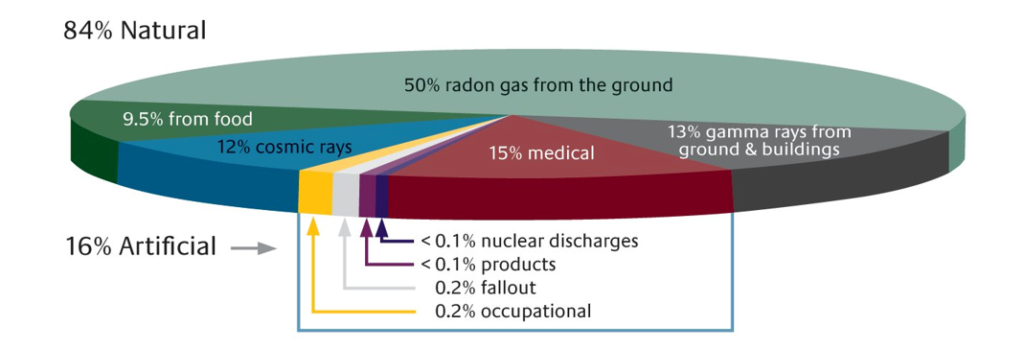
As you can see from the image above, approximately 84% of our average annual dose comes from natural sources of radiation. Leaving 16% from artificial / man-made sources which are predominantly from the medical field.
Health Risks of Radiation Exposure
The nature and severity of the biological effects, and how long it takes for them to appear, depends on the type of radiation; the amount of radiation absorbed; the rate at which it was received, and the organ or tissue affected.
For low levels of exposure, the biological effects can be so small they cannot be detected. The body is able to repair damage from radiation, chemicals and some other hazardous materials. Living cells exposed to ionising radiation could:
- repair themselves leaving no damage
- die and be replaced
- incorrectly repair themselves, resulting in a change or mutation
The induction of malignant disease is not a certain outcome of exposure at any level of dose. But the possibility of induction does increase with dose and that is why we have to restrict an individual’s exposure.
Sensitive Populations: Children, pregnant individuals, and those with compromised immune systems are more vulnerable to radiation effects.
Radiation Safety Principles
Radiation awareness is built on three key safety principles:
- Time – Limit the duration of exposure to reduce the total dose received.
- Distance – Increase the distance from the radiation source to lower exposure levels.
- Shielding – Use protective barriers such as lead aprons, concrete walls, or specialised containers to block or absorb radiation.
In occupational settings, additional measures include:
- Wearing dosimeters to track cumulative exposure.
- Using remote handling tools for radioactive materials.
- Following strict operational protocols and emergency procedures.
Awareness and Education
Radiation awareness is an essential part of staying safe in environments where ionising radiation is present. By understanding the fundamentals of radiation and its potential effects, you can take simple yet effective steps to protect yourself and those around you.
Being informed about safety measures, and following workplace protocols, helps create a safer and more secure workplace. Plus, knowing how to respond to potential incidents ensures everyone can work with confidence and peace of mind.
SGA have developed a Radiation Protection Awareness for X-ray course, available on our Online Learning Platform or live via Microsoft Teams, which is aimed at any employees working at a site that uses x-rays and covers the fundamentals of radiation and radiation protection.
Although some employees may not be closely involved with working with x-rays, it is a Health & Safety Executive requirement that all those involved in work, or affected by work, with ionising radiation are provided with suitable and proportionate information to avoid being unnecessarily exposed to ionising radiation.
The Role of Regulation
Radiation use is governed by strict regulations. Anyone working with any form of ionising radiation must comply with the Ionising Radiations Regulations 2017 (IRR17).
IRR17 provides a framework which requires employers to reduce exposure to ionising radiation to as low as reasonably practicable. Including naturally occurring substances such as radon.
They require employers to carry out thorough risk assessments before starting any radiation‑related activity, set clear dose limits, monitoring obligations, and emergency arrangements, alongside requirements for training and information to improve workforce understanding of radiation hazards.
Conclusion
Radiation awareness is the power to protect yourself and others from something you can’t see, smell, or touch—but can control with knowledge. In workplaces, training transforms caution into confidence, ensuring everyone works safely and effectively.
Radiation need not be feared by it must command your respect and awareness is our first and most effective line of defence!