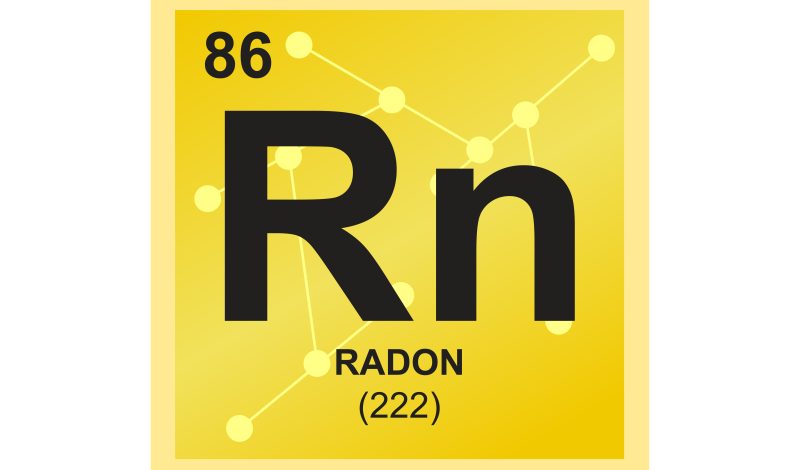
Radon is a naturally occurring radioactive gas formed by the radioactive decay of radium, thorium and uranium in rocks and soil. It is everywhere – it permeates into the open air and is the largest component of radiation dose to any member of the UK population, accounting for around 50% of our average background radiation dose. The average annual background radiation dose to the UK population is approximately 2.7mSv.
Where is Radon found?
There is background radiation everywhere, but Cornwall is on average more radioactive than other parts of the British Isles due to the composition of the underlying rock. The average annual background radiation dose to the Cornish population is 7.8mSv.
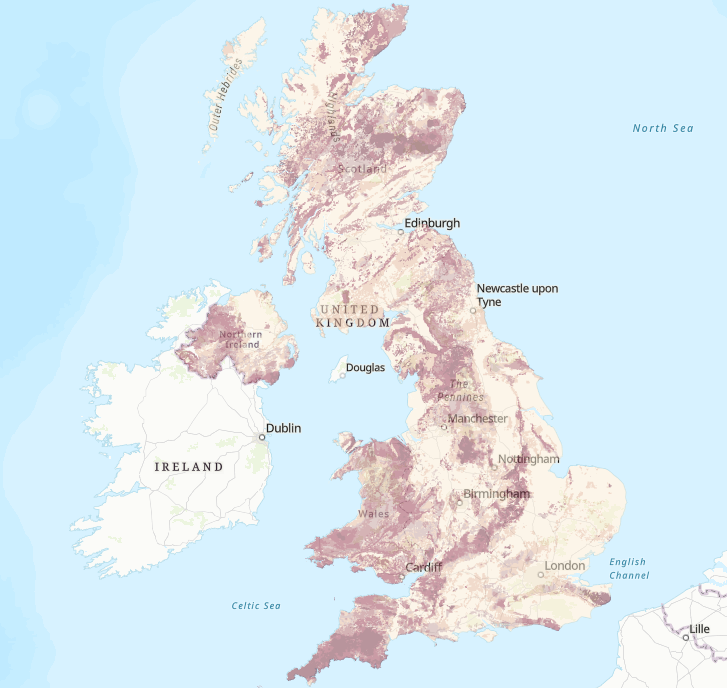
The UKHSA has published a map showing where high radon levels are more likely (2022 map shown). The darker the colour on the map, the greater the chance of a high radon level in a building. However, not all buildings, even in the darkest areas, have high levels; levels are usually low to negligible.
As radon gas is created in the ground under buildings it can seep to the surface and into buildings via cracks in foundations, floors and walls, gaps around pipes etc. Radon accumulation is an active process, there is a negative pressure in buildings compared to the surrounding ground, so radon is essentially drawn into the building.
The Risks
In the open air, radon concentrations quickly dilute to low levels. On average, in the open air, radon levels are approximately 4 Bq/m3 across the UK. Although in buildings, radon can become trapped and build to dangerous concentrations. The average radon level inside UK homes is 20 Bq/m3. Public Health England advise that ‘for levels below 100Bq/m3 your individual risk remains relatively low and not a cause for concern’.
Buildings with basements are more susceptible to high levels of radon as there is a larger surface area in contact with the soil through which the gas can permeate.
When levels of radon are high, the radioactive decay products are inhaled and enter our lungs, where they continue to emit radiation which can potentially cause localised damage.
The higher the level and the longer the period of exposure, the greater the risk!
The gas accounts for the second largest number of lung cancer cases in the UK, second to smoking.
Detecting Radon in Buildings
Radon is a colourless, odourless and tasteless gas. Special equipment is, therefore, needed to detect it.
In March 2017 Public Health England published the ‘Radon in Homes in England 2016 Data Report’. This summarised approximately 525,000 radon measurements between 1980 and 2015 and can be used to conduct an initial postcode radon assessment. Although the actual level of radon at an address can only be determined through monitoring.
Radon monitoring can be achieved using passive detectors that are positioned within the building, preferably at around breathing height (1 – 2 metres off the ground). After a set period these monitors are then returned for laboratory analysis. As levels vary daily due to weather conditions, temperature and atmospheric pressure a three-month monitoring period is usually recommended to take this into account.
Reducing Radon Levels in Buildings
Although radon is everywhere and is a harmful radioactive gas, extensive research has taken place in order to understand how to mitigate the risks posed.
The current action levels for UK homes is 200Bq/m3 and for commercial premises is 300Bq/m3.
There are numerous options available to successfully reduce radon levels within a building and prevent future build-up of the gas, including:
Positive pressure ventilation systems (installed inside the building) increase the pressure in the room. Where indoor pressure is greater than outdoor air pressure it acts as a barrier, preventing radon infiltrating.
Radon sumps (internally or externally depending on the configuration of the building): a sump creates a pocket of negative pressure under the building that radon gas will preferentially accumulate in. The sump is connected to pipework which houses a fan that then takes and releases the radon gas at a higher level away from the building.
Decisions on which mitigation option to choose depends on several factors for example the building type and age, listed status, foundation structure etc.
Radon in the Workplace
Under the Health and Safety at Work Act 1974 employers must, as far as reasonably practicable, ensure the health and safety of employees and other people who have access to their work environment.
The Ionising Radiations Regulations 2017 (IRR17), enforced by the HSE, come into effect for any work carried out in an atmosphere containing radon at an annual average activity concentration in air exceeding 300 Bq/m3 irrespective of whether there is any other source of ionising radiation used / kept on site. In this situation, employers are required to restrict the radiation exposure to their employees and should appoint a Radiation Protection Adviser (RPA). In this instance, SGA may be able to assist you – see our website for further details.
If you are concerned about Radon levels in your home / workplace, see UKradon – Home for further information.