From the northern lights to radioactive reindeer, we’ve managed to round up 12 Christmas fun facts based on the topic of radiation!
- Lapland, the official home of Santa Claus, is also one of the best places to catch a glimpse of the Northern Lights. The northern Lights being the result of cosmic radiation interacting with and ionising the atmosphere.
- On Boxing Day in 1898, Marie and Pierre Curie announced the discovery of a new radioactive element – Radium. Having discovered the element a few days previous they spent Christmas evenings watching the blue/green glow of heated Radium!
- First sold in 1979, and no doubt a popular Christmas gift that year, the Star Trek ‘phaser’ gun was the first toy to have a weak laser beam incorporated.
- Many of us will indulge in a brazil nut or two over the festive period. However, they do have a reputation for being one of the most radioactive foods due to their high level of radium content. But don’t let that put you off! Their radioactivity levels are relatively low, posing little risk when consumed.
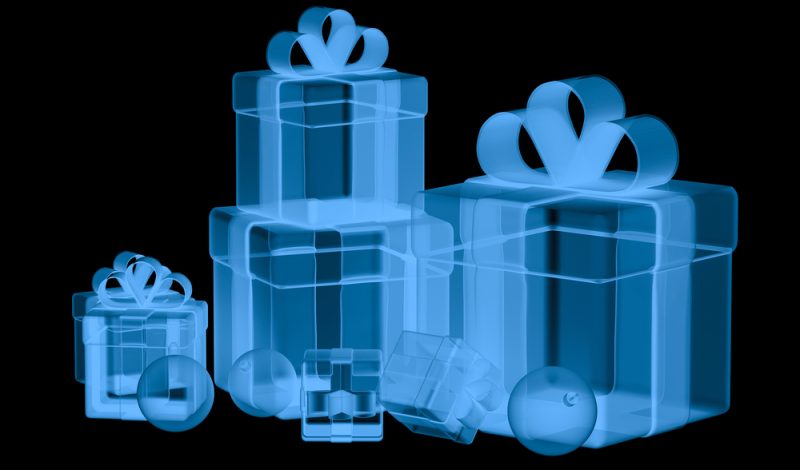
- Christmas fairs have long been popular places to gather and have fun. At fairgrounds in the early 1900’s x-rays were a common attraction. People stood in line for a chance to see their bodies in x-ray light!
- Rudolph the radioactive reindeer! The reindeer of northern Lapland carry a high level of radioactive dose, mainly cesium-137. This is due to the fallout from Soviet atomic bomb tests compounded by the Chernobyl disaster – the reindeer eat the lichen, moss and fungi which bioaccumulate radioactive deposits from the fallout.


- On Christmas Eve 1968, Apollo 8 orbited the moon 10 times. It was the first crewed spacecraft to reach the moon. The crew were the first humans to travel through the Van Allen Radiation belts (zones of energetic charged particles) and to record their actual radiation doses each crew member wore a Personal Dosimeter which transmitted data back to earth.
- The Christmas holidays and lights have long been connected and we owe these colourful holiday displays to the electromagnetic spectrum. Different types of electromagnetic energy are classified along a spectrum according to their wavelengths and energy content. The only electromagnetic spectrum wavelengths we can see are ‘visible light’ waves. Different colours of visible light are formed according to the distance between the peaks of lights waves – how far the peaks of the wave are from each other changes the colour our eyes perceive. Of the waves we can see, red has the longest wavelength and violet the shortest.
- Gold! Gold has been associated with Christmas time since the birth of Jesus when the three wise men gifted Gold, Frankincense and Myrrh. However, did you know it is also a great ionising radiation protection material? One example being that gold plating is often used to shield satellite surfaces as it reduces the amount of solar radiation absorbed by the satellite.
- Stars hold profound significance in Christmas tradition, representing the Star of Bethlehem which led the three wise men to baby Jesus. But did you know that stars emit various forms of radiation, including infrared radiation, ultraviolet light, thermal radiation and x-rays?
- Born on Christmas Day in 1642, Sir Isaac Newton is accredited with discovering the Spectrum of Colours. He proved that white light is not a single entity but a mix of colours and identified the colours that make up the ‘visible spectrum’. The visible spectrum is a narrow band within the electromagnetic spectrum that can be seen by the human eye.
- Still looking for that special Christmas gift? In the early 20th Century, your secret Santa gift may well have contained Radium, an extremely radioactive element. Before the effects of radiation exposure were well understood, Radium, purported for its healing properties and glow-in-the-dark novelty, was used in products such as soap, chocolate, cosmetics, clocks, watches and toys.
To find out more about ionising radiation, register on our Online Learning Platform to access a selection of free short courses, or explore our website to see what services we offer.