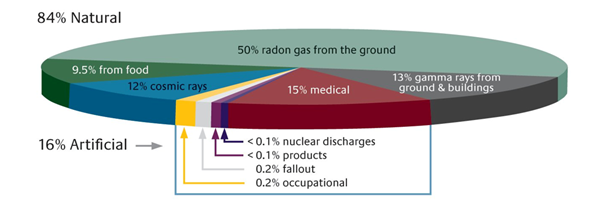
We are surrounded by many different forms ionising radiation emanating from a variety of sources, both natural and man-made. Public Health England (PHE) has calculated that, on average, the UK population is exposed to approximately 2.7mSv of ionising radiation per year. Natural sources of radiation account for 84% of this annual radiation dose with 16% coming from artificial sources, such as medical imaging.
Breakdown of Radiation Dose to the UK population
Natural Sources of Ionising Radiation
Naturally occurring radiation has been present in the Earth’s environment since its formation, exposing all living things to ionising radiation. Natural sources of radiation can be divided into three groups:
- Cosmic Radiation
Sources of radiation that come from the sun or outer space.
The northern / southern lights are the result of cosmic radiation interacting with our atmosphere. The Earth’s atmosphere shields the Earth from the majority of cosmic rays, but some do enter and collide, and interact with gas molecules and atoms, resulting in the formation of light – the Aurora Borealis.
Exposure to cosmic radiation increases with altitude, therefore, when we fly, we increase our dose from cosmic radiation. As an example, a flight to Spain gives the equivalent of approximately 10 microsieverts worth of dose – 10 microsieverts is about the dose that you would receive from a couple of dental x-rays.
- Terrestrial Radiation
Terrestrial radiation is due to the decay of radioactive materials in the Earth. Most geological materials, soils, rocks in the ground contain natural uranium, thorium and radium at different levels.
Radon is formed by the radioactive decay of uranium in rocks, soil and groundwater, it is a colourless, odourless radioactive gas and accounts for 50% of our average background radiation dose. Radon is likely the largest component of dose to any member of the UK population. There are areas of the country where the levels are particularly high. In the UK, Cornwall is on average more radioactive than other parts of the country. This is due to the granite bedrock, an igneous rock which produces radon more rapidly than most other rock types. The average annual dose to the Cornish population is 7.8mSv, compared to the average annual dose for the UK being 2.7mSv.
The UKHSA has published a map showing where high radon levels are more likely and The Ionising Radiations Regulations 2017 (IRR17) come into effect where:
- radon is present above the defined level of 300 Bq/m3 (as an annual average), and
- employers are required to take action to restrict resulting exposures
- Internal Radiation
All food and drink contain trace quantities of natural radioactivity. A number of radioactive substances are absorbed by plants and animals from the soil or water in their environment. As a result, these substances also enter the food chains that make up our diet. The major isotope found is potassium 40. Potassium rich foods include bananas, root crops and meat. As another example, if you drink a glass of mineral water daily, every year, then you are likely to receive a dose of around about 65 microsieverts from the internal radioactivity. Mineral waters are often extracted from deep water deposits and therefore have a high concentration of dissolved minerals.
Artificial Sources of Ionising Radiation
In addition to natural background radiation, individuals are also exposed to radiation from various artificial sources, the most considerable of which is the use of x-rays in medical diagnostics.
Doses received from medical diagnostics vary greatly depending on the modality and / or technique, as we can see from the chart below:
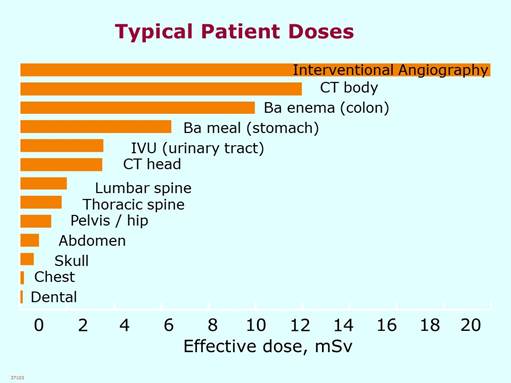
The smallest of these doses are from dental imaging, which are in the range of between one to ten microsieverts for intra-oral imaging.
As the dose received is a function of the dose rate and time, it is unsurprising that the largest medical doses come from interventional imaging. Interventional radiology is image guided procedures to diagnose and treat disease in nearly every organ system. Doses in this example can be in the range of 20 millisieverts or 20,000 microsieverts.
Less than 1% of our annual background dose comes from a combination of other sources of artificial radiation including, but not limited to:
- Radiation released during the generation of nuclear power
- Radioactive fallout from nuclear weapons
- Consumer products (ie – smoke detectors, luminous watches / clocks)
- Commercial fertilisers
As a result of both natural and artificial sources, radiation is constantly present in our environment; we are exposed to it every day – there is no escape!
When working with ionising radiation, there are strict precautions to be followed in order to ensure safety and to reduce occupational exposure. Any employer engaged in work with ionising radiation must appoint a suitable Radiation Protection Advisor (RPA) in accordance with Regulation 14 of the Ionising Radiation Regulations 2017. See our website for further details.